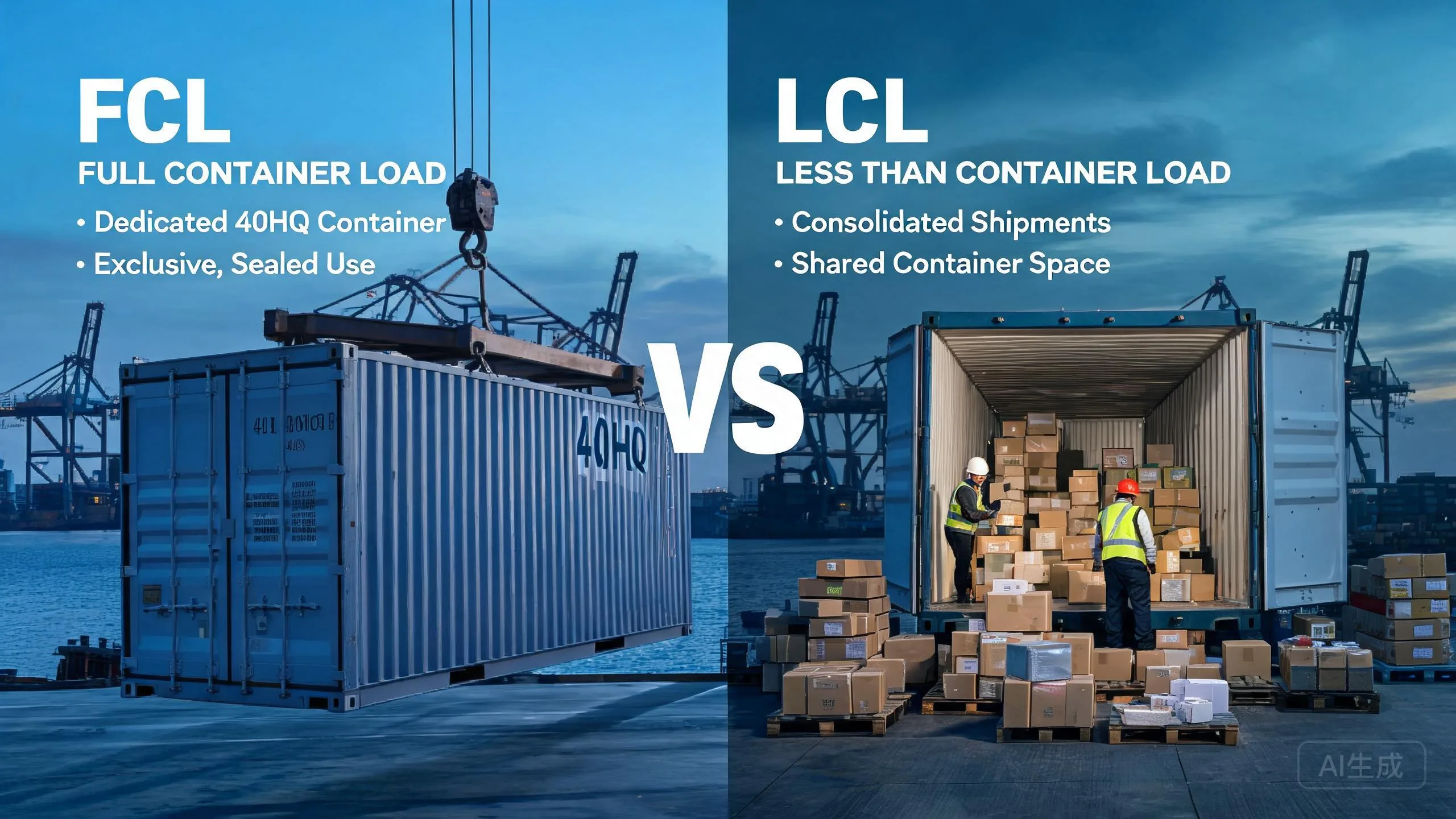
FCL vs LCL Shipping: Which Is Cheaper?
FCL (Full Container Load) and LCL (Less than Container Load) are the two main ocean freight options from China. FCL is cheaper for shipments over 15 CBM; LCL is cheaper under 15 CBM. This guide compares cost, transit time, and when to choose each.
When shipping ocean freight from China, the first decision is FCL (Full Container Load) or LCL (Less than Container Load). This choice affects your cost, transit time, cargo safety and customs process. The general rule: FCL is cheaper per CBM for large shipments, LCL is cheaper for small shipments. But the break-even point, transit difference and handling considerations deserve a closer look.
FCL (Full Container Load)
FCL means your cargo fills an entire container - typically a 20GP (28-30 CBM capacity), 40GP (54-58 CBM) or 40HQ (65-76 CBM). You pay a flat rate per container regardless of how full it is. The container is loaded at your supplier's factory, sealed, trucked to the port, shipped, and trucked to your destination. No other cargo is mixed in.
- Pros: Cheapest per CBM for large volumes. Fastest transit (no consolidation). Sealed container for security and cargo safety. No CFS handling charges at origin or destination. Simplifies Amazon FBA FC appointments.
- Cons: You pay for the full container even if it is half empty. Not cost-effective for small shipments under 15 CBM.
LCL (Less than Container Load)
LCL means your cargo shares a container with other shipments. The forwarder consolidates multiple suppliers' cargo into one container at a Container Freight Station (CFS) warehouse. At destination, the container is deconsolidated and each shipment is released to its consignee. You pay per CBM (cubic meter) or per ton (whichever is greater).
- Pros: Cheapest for small shipments under 15 CBM. Only pay for the space you use. Flexible - ship any volume from 0.1 CBM upward. Can consolidate multiple suppliers into one LCL shipment.
- Cons: Slower transit (3-5 days consolidation at origin, 2-4 days deconsolidation at destination). Additional CFS charges per CBM at origin and destination. Cargo mixes with other shipments (risk of damage if not packed properly). LCL rates per CBM are higher than FCL per-CBM equivalent.
Cost Comparison: FCL vs LCL
| Shipment Size | FCL 20GP Rate | LCL Rate | Recommendation |
|---|---|---|---|
| 5 CBM | from USD 1,800 per 20GP | from USD 2.5 per CBM | LCL (much cheaper) |
| 10 CBM | from USD 1,800 per 20GP | from USD 2.5 per CBM | LCL (still cheaper) |
| 15 CBM | from USD 1,800 per 20GP | from USD 2.5 per CBM | Break-even (compare rates) |
| 20 CBM | from USD 1,800 per 20GP | from USD 2.5 per CBM | FCL (cheaper per CBM) |
| 28+ CBM | from USD 1,800 per 20GP | N/A - use FCL | FCL |
| 65+ CBM | from USD 2,800 per 40HQ | N/A - use FCL | FCL 40HQ |
LCL rates include origin CFS charges, ocean freight and destination CFS charges. FCL rates include origin port charges, ocean freight and destination port charges - but not customs clearance, duties or inland delivery. For a true comparison, request both FCL and LCL all-in DDP quotes from us.
Transit Time Comparison
| Route | FCL Transit | LCL Transit | Difference |
|---|---|---|---|
| China to USA West Coast | 18-25 days | 24-32 days | +6-8 days |
| China to USA East Coast | 28-35 days | 32-40 days | +6-8 days |
| China to Europe | 32-40 days | 38-46 days | +6-8 days |
| China to UK | 30-38 days | 36-44 days | +6-7 days |
| China to Australia | 20-28 days | 26-34 days | +6-7 days |
| China to Southeast Asia | 7-14 days | 12-18 days | +5-6 days |
LCL transit is 5-8 days longer than FCL due to origin consolidation (3-5 days) and destination deconsolidation (2-4 days). If your deadline is tight, FCL is the safer choice.
When to Choose FCL
- Volume over 15 CBM: FCL flat rate is cheaper than LCL per-CBM rate at this threshold.
- Fast transit needed: FCL saves 5-8 days vs LCL.
- Fragile or high-value cargo: Sealed container prevents damage from mixing with other cargo.
- Amazon FBA: FCL simplifies FC appointments and reduces handling at destination.
- Cargo requires temperature control: Reefer containers are FCL only.
- Security-sensitive cargo: Sealed container from factory to destination.
When to Choose LCL
- Volume under 15 CBM: LCL per-CBM rate is cheaper than FCL flat rate.
- Small orders or samples: Ship from 0.1 CBM without filling a container.
- Multiple suppliers: Consolidate cargo from different factories into one LCL shipment.
- Flexible delivery timeline: If you can absorb the extra 5-8 days, LCL saves cost.
- Testing a new product: Small first order before committing to FCL volume.
Container Sizes & Capacities
| Container | Internal Dimensions | Max Capacity | Max Payload | Best For |
|---|---|---|---|---|
| 20GP | 5.89 x 2.35 x 2.39 m | 28-30 CBM | ~28 tons | Heavy dense cargo (tiles, machinery) |
| 40GP | 12.03 x 2.35 x 2.39 m | 54-58 CBM | ~26 tons | Standard volume cargo |
| 40HQ | 12.03 x 2.35 x 2.69 m | 65-76 CBM | ~26 tons | Light bulky cargo (furniture, electronics) |
Frequently Asked Questions
What is the difference between FCL and LCL shipping?
FCL (Full Container Load) means your cargo fills an entire 20GP, 40GP or 40HQ container. You pay a flat rate per container. LCL (Less than Container Load) means your cargo shares a container with other shipments. You pay per CBM (cubic meter). FCL is faster (no consolidation) and cheaper per CBM for large shipments. LCL is cheaper for small shipments under 15 CBM.
Which is cheaper: FCL or LCL?
For shipments under 15 CBM, LCL is cheaper because you only pay for the space you use. For shipments over 15 CBM, FCL is cheaper because the flat container rate beats the per-CBM LCL rate. The break-even point is typically 12-15 CBM depending on the destination and current rates. LCL has additional origin and destination charges (CFS fees) that FCL does not, so the effective break-even is higher than the raw rate comparison suggests.
How long does FCL shipping take vs LCL?
FCL is typically 5-10 days faster than LCL to the same destination. LCL requires consolidation at origin (3-5 days) and deconsolidation at destination (2-4 days), adding a week to the total transit time. FCL containers are loaded at the factory, sealed, and shipped direct with no consolidation or deconsolidation.
When should I choose FCL over LCL?
Choose FCL when: (1) your cargo is 15 CBM or more; (2) you need faster transit (no consolidation); (3) your cargo is fragile or high-value (no mixing with other cargo); (4) you need a sealed container for security; (5) you are shipping to Amazon FBA (FCL simplifies FC appointments). Choose LCL when your cargo is under 15 CBM and transit time is not critical.
Still not sure whether FCL or LCL is right for your shipment? Send us your cargo details and we will quote both options with an all-in DDP rate so you can compare. Or learn more about our ocean freight service.
Get FCL and LCL quotes
We quote both FCL and LCL options for your shipment so you can compare cost and transit time side by side.